From the Dahlonega Plateau to Dillard, Doghobble brings Georgia wine, robust local grapes, and a distinctly regional approach to The Dillard House.
There is a shrub growing along Appalachian creeks called doghobble, an evergreen accustomed to steep banks, wet ground and the particular conditions of the Southern mountains. Its roots help stabilize the soil along waterways against erosion, and when Samuel Zamarripa and his partners went looking for a name for their North Georgia wine operation, they found it in a plant unassuming yet vital to the ecosystem in which it exists.
“We want to be known as a natural part of the Southeast of the United States,” Zamarripa said of the name.

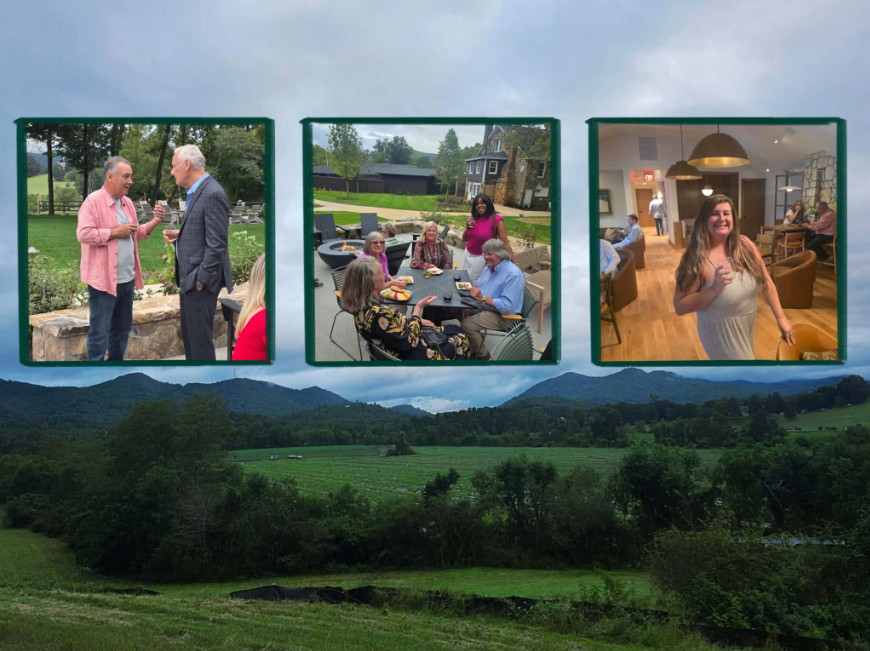
That idea—paying attention to what belongs here—came up repeatedly at a reception celebrating Doghobble’s arrival at The Dillard House, where Familia Vineyards has established a satellite tasting room on the historic property.The doghobble plant gave the winery its name, but the idea behind that choice extends into the vineyard, where the team is paying close attention to grapes that belong here, too. It leads to a question they seem genuinely interested in answering: What should a wine from the Southeast actually taste like?
The Business Behind Doghobble in Dillard
For Zamarripa, Doghobble’s arrival in Dillard brings together two Georgia ventures that had percolated in his mind like the elements of a wine not yet blended. He had known Dillard for decades and had considered working with The Dillard House even before Legacy Ventures purchased the property from the Dillard family, beginning a new chapter for the longtime North Georgia landmark while preserving the history and traditions that had made it a destination for generations. The connection began to take shape after the acquisition, when Zamarripa serendipitously encountered Legacy Ventures founder and CEO David Marvin, whom he already knew, at a dinner.
Zamarripa brought up his interest in The Dillard House and proposed adding a winery operation to the property. Months later, he said, they had a contract and construction began. Doghobble became the first outside operation to open there following the purchase.

For those of us who have been coming to The Dillard House for years—and, in my family’s case, across generations—attending a reception that marks, in part, the beginning of a new era for this beloved local landmark feels a little like witnessing history in the making.
The man in the salmon shirt moving easily among the guests, making introductions and greeting friends with seemingly inexhaustible good humor, has taken an unlikely path to this room in Dillard.
From the Georgia Senate to a Georgia Vineyard
I met Zamarripa via email after he kindly reached out to praise an article I had written about a reception at The Dillard House. It made my whole day. Since then, he has been liberal with his advice, made introductions on my behalf, and taken a genuine interest in the magazine I have been building, though he had absolutely no obligation to do any of it.
That ability to glide through a room with such easy bonhomie made considerably more sense when, while checking the spelling of his name, I stumbled across his Wikipedia page. Suddenly, it all clicked. He had spent years in a profession where walking into a room full of strangers and leaving with friends was practically part of the job description.
In 2002, Georgia voters elected Zamarripa as the first Hispanic member of the Georgia State Senate, where he represented District 36 from 2003 through 2006. He also helped establish GALEO, the Georgia Association of Latino Elected Officials, alongside Pedro Marin and Tony del Campo in 2003, extending his work in Hispanic civic leadership beyond the Capitol. The University of Georgia’s Richard B. Russell Library now preserves his papers as part of its Latinos in Georgia: Politics and Public Policy Archive.
Yet these days, Zamarripa will tell you he is primarily a wine man in a wine family. Hence the name: Familia Vineyards.
Familia Vineyards
Doghobble is part of Familia Vineyards, whose Georgia footprint extends considerably farther than the new tasting room at Dillard.
Zamarripa explained that the family also owns Horse Creek Winery in Nashville, Georgia, a vineyard with more than three decades of history that had belonged to his wife’s family. They purchased the vineyard in 2019, he said, expanding their ability to produce wine and support their other operations.

The North Georgia side of the business has given Familia Vineyards an opportunity to explore grapes particularly suited to this part of the country, and Zamarripa speaks about that pursuit with the alacrity of a real-life Johnny Appleseed—if Johnny Appleseed had been planting grapevines.
“We grow grapes that are native to this region,” he told me, describing the company’s emphasis on American varieties and contrasting them with grapes more commonly associated with California or European wine regions.
The question becomes especially interesting when you consider how young Georgia’s modern wine industry remains compared with regions Americans immediately associate with wine. California has spent generations developing its identity in the minds of consumers, while European wine regions have had centuries.
The people behind Familia Vineyards are figuring out what Georgia itself can grow particularly well and determining how to tell the world. Somewhere among those vines may be a new starlet waiting in the wings, ready to take the stage beside the better-known grapes that already command the marquee.
What Does the Southeast Grow?
During another conversation that evening, the question emerged in wonderfully simple terms: Napa has Cabernet, Oregon has Pinot Noir, but what does the Southeast have?
Some of the answers come with grape names unfamiliar to casual wine drinkers.
The team discussed varieties selected because they perform well under Southeastern conditions, including grapes that remain relatively obscure to consumers accustomed to walking into a grocery store and choosing among familiar Cabernet, Chardonnay, or Pinot Noir labels. Their decisions account for Georgia’s climate, the behavior of individual varieties, and what actually succeeds in the vineyard.

That philosophy continues after harvest. Members of the winemaking team described a minimalist approach beginning in the vineyard and continuing through the cellar, with an emphasis on clean wines and limited intervention between what happens in the field and what eventually reaches the bottle.
Nathan Dane, a founding partner and the company’s CFO, described choosing varieties that grow successfully here while requiring relatively little chemical intervention.
Dane’s title only partially describes his job. As CFO and a founding partner, he measures how the business is performing and helps the team understand data coming in from its various points of sale, but a young winery apparently has little respect for corporate job descriptions. Depending on the day, Dane said, he may also serve wine, make a delivery, clean or head into the vineyard to harvest grapes.
No Beret Required
Just as Planet Fitness has made a name for itself as the everyman’s gym, Doghobble wants to make good wine feel similarly approachable: a place to enjoy a high-quality glass without the side of snobbery. No “lunk alarm” will sound if you wander in wearing a beret with a long-stemmed cigarette dangling from your fingers—but, thankfully, neither is required.
Wine can be intimidating, particularly when a tasting begins to feel as though someone may hand you a Scantron and ask you to identify notes of graphite before allowing you to leave.
Dane described Doghobble’s friendlier approach.
“We don’t pretend to be like elites or to know everything there is to know about wine,” he said.
Customers can tell the staff what they have enjoyed before, describe the flavors they tend to like, and allow the person behind the counter to guide them toward something in the Doghobble portfolio. Dane said those candid conversations have become central to the way they serve visitors.
You don’t need to arrive knowing the vocabulary. You can simply like the wine.
The education can follow.
Friends & Felonies
That approachability carries naturally into the new Dillard tasting room itself.
Inside, enjoy vaulted ceilings of arched pale wood, and broad windows which give way to a patio bordered by stone, with fire features surrounded by chairs and the green grounds of The Dillard House stretching beyond them. It is an exceptionally easy place to order a glass, settle into a fireside Adirondack chair and pretend, briefly, that you are Martha Stewart on her front porch.

Indeed, at Doghobble’s opening reception, I joined a circle around one of the round fireplaces with people I had never met, wine glasses in hand, and within minutes we were rollicking through conversations that ran the gamut from potential alibis for as-yet-uncommitted felonies, the wooden boats of Lake Rabun, the finer points of the differences between Ingles and Walmart, and naturally, which wine we liked best. We departed as firm acquaintances and potential future cellmates.
The wine gives everyone a perfectly good reason to gather, while the patio and fire invite easy confidences and the increasingly lost art of conversation. By the end of the evening, people who had arrived as strangers were laughing together around the fireplace, half-finished glasses in hand, eagerly discussing which glass they would order next.
A Proud Distinction
Few people realize this, but Doghobble’s North Georgia operation sits within a part of the state where geography becomes surprisingly consequential to what ends up in the glass.
Zamarripa discussed the Dahlonega Plateau American Viticultural Area, or AVA, a federally recognized grape-growing region defined by geographic features that distinguish it from surrounding areas.
Even within North Georgia, conditions can change considerably over a relatively short drive. Zamarripa pointed to the elevation difference between Dillard and Dahlonega as one example, explaining that several hundred feet can materially affect grape growing.

For a visitor, Dahlonega and Dillard may register simply as two mountain destinations connected by a drive through North Georgia. For a farmer deciding which grape to put into the ground, those differences matter.
A Toast to What Comes Next
After spending the evening with the people behind Familia Vineyards, I kept returning to the doghobble plant.
The company could have selected any number of mountain references for a bottle of North Georgia wine. They chose a plant that actually grows here, along Appalachian waterways, where its roots perform a practical job holding soil against the creek bank. Sam explicitly connected that choice to the company’s desire to identify itself with the Southeast.
Now they have carried that philosophy north to Dillard, where you can sit beside a fire with a glass of regionally specific wine, strike up a conversation with somebody you met five minutes earlier and look across grounds that North Georgia families have been visiting for generations.
Somewhere between the doghobble growing beside an Appalachian creek, the unfamiliar grape growing on a Georgia vine, and the glass being passed across the counter at The Dillard House, Familia Vineyards is working on an answer to a deceptively simple question:
What does Georgia taste like?