The Chattahoochee Mountain Fair this year, quite frankly, stands out as a triumph.
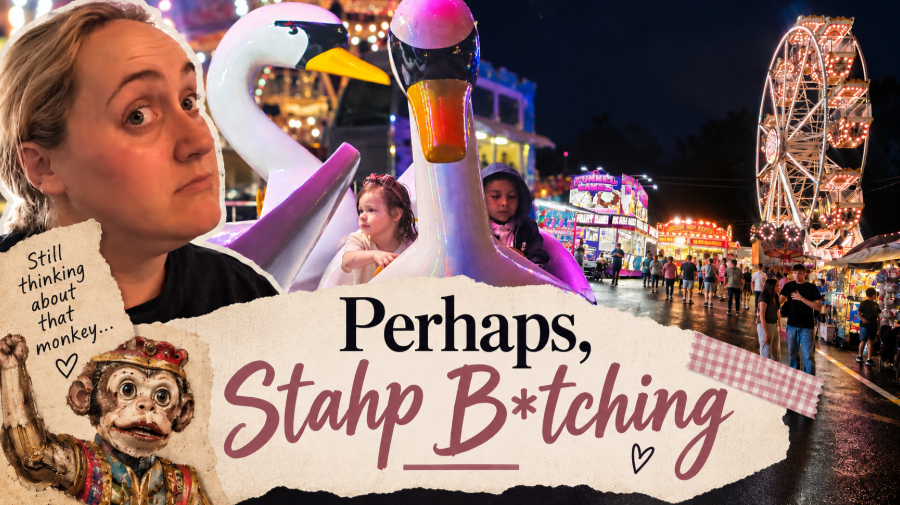
After considerable work by the fair board, the aging and increasingly dreary Midway Rides Unlimited midway disappeared, replaced by Lisko Family Amusements and a carnival that looked almost startlingly pretty against the North Georgia skyline. There were rides for little children, bigger rides for teenagers, and no fewer than three—yes, THREE—Ferris wheels, whose glowing spokes turned above the fairgrounds while my three-year-old daughter stared up with eyes as wide as dinner plates, their colored lights reflected in her pupils.
I will concede one loss. I miss the terrifying monkey on the old carousel.
He sat among the carousel’s chipped horses as it groaned through another turn, wearing the expression of a creature who had seen dark things and signed a nondisclosure agreement requiring him to take them to his grave. Every year, I wondered why he was there, and every year, I was slightly afraid of him. Now that he is gone, I find myself inexplicably sentimental about the whole rickety contraption. Progress, apparently, requires sacrifice.
Still, families praised the expanded selection of children’s rides, while golf carts ferried parents, kids and strollers between the fairgrounds and parking areas. Behind it all, approximately 30 unpaid volunteers handled setup, kept the fair running for nine straight days and stayed through teardown.
Children received remarkably inexpensive admission, and on most nights adults could walk through the gate for less than the price of a fast-food combo meal.
Then came rodeo night.

Adult admission rose to $20, which included a rodeo that costs approximately $42,000 to produce, and the internet promptly rediscovered an immutable law of community events: you can replace the crummy carnival, bring in three Ferris wheels, keep children’s admission remarkably low, recruit dozens of people to work for free and spend $42,000 putting cowboys on angry livestock in cute costumes, but somebody who came for a funnel cake is still going to demand an explanation.
One woman wrote on a public Facebook forum that she and her husband arrived around 1 p.m., paid $40 between them, had no intention of attending the evening rodeo, spent more than $100 with vendors and left around 2:20—but not before returning to the ticket booth to announce that she had, as promised, successfully avoided the rodeo, apparently providing the attendants with some much-needed closure after her earlier attempt to negotiate a different admission price.


Other residents soon joined the discussion. Why couldn’t the rodeo have its own ticket? What about wristbands? Senior admission? A daytime rate? A refund for visitors who left before the rodeo began? One family said it cost $72 to get two adults and four children through the gate before they bought the ride wristbands they had actually come to use.
Cue the torches. Cue the pitchforks. Cue the person typing “YOU PEOPLE HAVE NO IDEA WHAT IT TAKES TO PUT ON A FAIR” with the righteous fury normally reserved for congressional testimony and SEC football.

Except, as it turns out, that person had a point, too.
According to Shelley Tullis, the long-time organizer of the fair, the rodeo costs approximately $42,000. The FMX show costs another $35,000. Four ground attractions run more than $40,000, while security and cleaning add approximately $30,000. We have already sailed past $147,000 before counting insurance, utilities, equipment, advertising, repairs, maintenance, supplies and additional entertainment. Thirty volunteers provide the human labor that keeps much of it functioning.
And suddenly we have arrived at the useful part of complaining.
Because somewhere between “THIS IS A RIP-OFF” and “IF YOU DON’T LIKE IT, STAY HOME” sits the increasingly endangered creature known as constructive criticism: the peculiar notion that we can appreciate the people doing a difficult job while still asking whether some portion of that job could be done differently.
I want to be clear: in this particular dispute, I am 100 percent on the side of the fair committee. I have attended the Chattahoochee Mountain Fair for years, through some considerably less glorious incarnations, and I am genuinely impressed by what the committee accomplished this year.
Which brings me, somewhat paradoxically, to the useful part of complaining.
I believe strongly in constructive criticism, including criticism posted publicly on Facebook. Public discussion gives residents an accessible and highly visible way to raise ideas, compare experiences, and occasionally put a problem directly in front of the public officials, organizers, and journalists who might be able to expand an ordinary citizen’s platform. But constructive criticism asks something of the critic, too: understand what you are criticizing, acknowledge what people have done well, treat the human beings involved with basic courtesy, and whenever possible, carry a worthwhile suggestion beyond the comment section to those who can actually make the meaningful changes one wishes to see.

So, yes, complain. Ask questions. Put the suggestion on Facebook where everyone can see it. Public discussion gives ordinary residents an extraordinarily accessible way to reach neighbors, and some genuinely good community ideas begin with somebody saying, “Could we do this differently?”
But bring the whole story with you. Remember the approximately 30 volunteers. Remember the cheaper nights and inexpensive children’s admission. Remember the atronomical expenses. Give people credit when they improve something, and direct your criticism toward the people who can actually consider it. A good suggestion becomes considerably more useful when it arrives with some understanding of the problem it proposes to solve.
The committee put countless hours into improving it, and my daughter saw three glowing Ferris wheels where I had grown accustomed to chipped paint and a carousel that sounded like it had been ignoring its check-engine light since the Clinton administration.
And yet, I still miss that monkey.
I have no idea where Midway Rides Unlimited takes a carousel monkey after his tenure at the Chattahoochee Mountain Fair ends, and I suspect I am happier not knowing. Wherever he is, I hope he understands that his replacement involved three Ferris wheels, a delighted three-year-old and an objectively better fair. He served his time and his country.
Godspeed, terrifying carousel monkey. You were creepy, inexplicable and, apparently, irreplaceable. Maybe constructive criticism should work the same way: recognize what deserves preserving, acknowledge what has improved, identify what could work better, and give the people doing the work enough grace to keep trying.
And when an organization has listened, worked, improved and delivered?
Perhaps, occasionally, stahp b*tching.