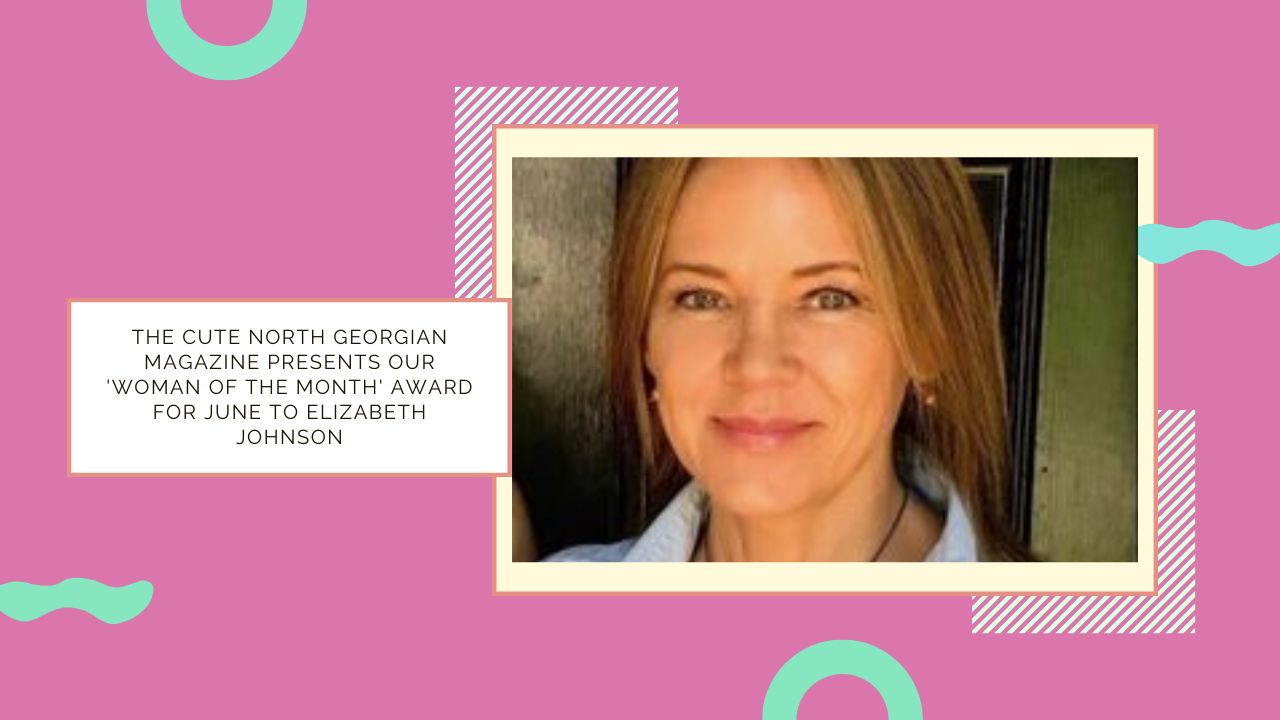
In the world of social service, certain names are so entwined with the mission that the two become indistinguishable from each other. As with Jane Addams and Hull House and Ashton Kutcher and Thorn, Elizabeth Johnson is indelibly linked to Jesse’s House in Forsyth County, embodying the cause she serves so diligently. Honored as The Cute North Georgian Magazine’s Woman of the Month for June, Elizabeth’s story is as rich and complex as her work.
The Roots: A World of Contrasts
Born in Poughkeepsie, New York, Elizabeth’s early life was a tapestry woven with diverse threads. In Poughkeepsie, she grew up in a largely working-class neighborhood, interspersed with middle-class families commuting into New York City or to the local IBM. A walk to school meant passing single-family homes with manicured lawns and greeting friends and neighbors, while always maintaining a child’s vigilance. This community thrived on simple values, where streetlights served as curfews, and cozy, hand-crocheted scarves—often crafted by a loving neighbor or mother—kept everyone warm in the winter.
However, the primary years of Elizabeth’s life were spent in Stony Brook on Long Island, where she was immersed in a community defined by the presence of SUNY University. “The students and faculty came from all over the world, creating a rich tapestry of diversity,” she recalls. This backdrop of progressive influence coexisted with a staunch commitment to preserving the town’s history. “We went to the Apothecary, not a CVS or Walgreens.” Indeed, when one researches Stony Brook, one notes well-maintained homes, top-rated schools, and a strong sense of community.
Moving from a working-class neighborhood in Poughkeepsie to this seaside community was a stimulating and transformative experience for Elizabeth. Yet, she never lost the Poughkeepsie values of humility and hard work that influenced her future in service and leadership.
The true contrast in Elizabeth’s upbringing came from her parents’ roots in Appalachia. Her father hailed from the southernmost region of Virginia, while her mother grew up in western North Carolina. The Appalachian Mountains, with their rugged beauty and austere nature, cast a significant influence on the lives of those who lived there. Elizabeth’s parents’ existence evokes images from the story of Coal Miner’s Daughter, marked by grit and determination in the face of hardship. “They grew up without indoor plumbing or central heat,” Elizabeth recounts, painting a vivid picture of a life worlds apart from her Long Island surroundings.
Elizabeth’s paternal grandparents were both college-educated—a rarity in their Appalachian community. Her grandfather, a coal miner from the age of 13, later felt called to serve in ministry. He earned his education through sheer determination, meeting Elizabeth’s grandmother, one of the first women fully ordained as an Elder in the Methodist Church.
“My oldest brother was born while my father was still working on his master’s degrees, which meant he had a family to support. It was during that time at Princeton that my father was installed as a minister at a Methodist church in upstate New York. Those years would turn out to be the staging area of his life’s work, as they would for my mother too,” she shares.
The Civil Rights Movement was underway, and just as he felt called to be a minister, her father also felt called to fight for justice. “He was by no means at the center of the movement, but he didn’t stand on the periphery either. He, along with ministers from neighboring churches, met with Dr. Martin Luther King and Ralph Abernathy to exchange ideas and organize marches.”
“My father marched on Washington in 1963 and heard Martin Luther King give his ‘I Have A Dream’ speech. My brothers and I were already born, so my mother didn’t go with him, but the way I see it, she was right there with him through all of his battles for justice. She just played a different role. On that morning, 28 August 1963, she got up in the early hours, made his lunch, and watched him leave as he went to board a bus at 4 a.m. Neither knew what the day might bring, or if he would even come back that night. No one knew if it was going to be a peaceful march or not. Her willingness to let him go without knowing what it would bring was her role on that occasion.”
It had been her parents’ intention to move back to southern Virginia when the opportunity presented itself, but her father’s involvement in the Civil Rights Movement changed all of that. Her grandfather, who was still working as a minister in the conference where her father wanted to serve, advised him that it might be best if he stayed in New York, where his involvement in the Civil Rights Movement would be supported or at least not put him or his family in any danger.
Her father would go on to fight for the rights of many through his almost 70 years of ministry. He fought for women to be equally recognized in the church as ministers back in the ’60s, long before it caught on and became a bigger fight. That battle gave way to fighting for the LGBTQ community to be welcomed as parishioners and clergy in the church in the ’70s. Along the way, he fought for people with disabilities, both physical and mental, and finally for the rights of the elderly. “I can’t really think of a community that he didn’t fight for,” Elizabeth notes.
He also started a few nonprofit organizations, one being the first 24-hour crisis line in the United States. “It’s called Response Crisis Center now, but it was just called Response in its early years. He met with someone from Australia who had created a crisis hotline, and from there he and some members in the community decided to create one in Stony Brook. It became a model for crisis hotlines around the country and is still in operation today. It’s one of the accomplishments he is most proud of.”
All of these remarkable people that came before her made Elizabeth who she is and led her to this place. “I am standing on their love, courage, determination, sacrifices, and hard work to be where I am.”
“For all of them, there is no higher calling in life than to serve others. They lived out the familiar verse in Matthew where Jesus said, ‘inasmuch as you have done it unto the least of these, you have done it unto me.’”
This unique blend of influences gave Elizabeth an appreciation for hard work and lifelong learning. As the daughter and granddaughter of educated activists from remote Appalachian states, she inherited a deep-rooted sense of service. Her family’s legacy of overcoming adversity with a spirit of giving instilled in her a commitment to community and compassion. Together, these experiences crafted Elizabeth into the dedicated leader we profile today, a woman deeply committed to making a difference in her corner of the South.
Finding Her Path
Elizabeth’s academic journey began at Drew University in New Jersey, where she majored in Psychobiology—now known as Neuroscience—a versatile major encompassing prerequisites for medical school, psychology, and neuroscience.
Initially pursuing a Ph.D., she shifted her path after discovering a master’s program at NYIT, which led to a full scholarship and a career as a clinician. “I always knew I wanted to serve and help others,” she explains. “I felt honored to hear their stories and be a part of their journey in recovery,” she says of her early work at a community center in Philadelphia.
Reflecting on that time, she writes, “I think of those years early in my career as the golden days of therapy. I finished my master’s in 1987, so I started my career in a time before insurance companies dictated treatment and would only reimburse for a few sessions. I got to see people turn their lives around and become someone they never imagined they could be. I still think back on some of them and marvel at what they overcame and where they ended up. They weren’t all success stories—it never is in any field of Human Service—but there were enough to make me feel lucky to be working with these good souls that had been through so much.”
Her role as a clinician provided invaluable lessons and a deep appreciation for the resilience of her clients, reinforcing her commitment to making a meaningful impact in the lives of others.
Jesse’s House: The Perfect Fit
“Throughout my career, I have worked with women primarily. When I worked at the community center in Philadelphia, my role as a clinician was supported by a grant whereby 75% of my caseload had to be women. That job more or less set the tone for what was to follow. As a woman myself, a mother of three daughters, with a focus on providing therapy for women in my professional career, working at Jesse’s House seemed like a great fit. I met with the Executive Director at the time and she agreed, so she put it all in motion.”
It’s only natural that a facility with a mission like Jesse’s House would attract someone like Elizabeth. Her involvement began in 2016 as a therapist, and her commitment and admiration for the organization’s mission led her to accept the role of Program Director in 2017 and eventually Executive Director in 2020. Under her leadership, Jesse’s House transitioned to a trauma-informed program, effectively addressing the complex needs of the girls in their care.
The challenges were immense, from managing trauma-induced behaviors to navigating the operational intricacies exacerbated by the pandemic. Yet, Elizabeth’s vision and dedication have been unwavering. “Caring for the girls means caring for all of the unsung heroes I work alongside,” she emphasizes, highlighting the essential role of her team in this journey. In my conversations with Elizabeth, it is abundantly clear her appreciation of her team.
Looking Ahead: Renovation and Renewal
One of Elizabeth’s most exciting initiatives is the major renovation of the resident building at Jesse’s House. “It’s going to make a world of difference for the girls and the staff,” she enthuses. This project, alongside the creation of a Transitional Living program for older girls, represents her ongoing commitment to improving the lives of those in her care.
One of Elizabeth’s most exciting initiatives is the major renovation of the resident building at Jesse’s House. “It’s going to make a world of difference for the girls and the staff,” she enthuses. This project, alongside the creation of a Transitional Living program for older girls, represents her ongoing commitment to improving the lives of those in her care.
The renovation transforms Jesse’s House into a welcoming and aesthetically pleasing home, with comfortable amenities that provide a profound sense of security and pride for the girls. Unlike a typical homeless or domestic violence shelter with thrifted furniture, this home is thoughtfully designed to create an environment of stability and care. Such surroundings significantly influence the girls’ self-worth, offering them a sense of dignity and belonging. By mitigating their fears and providing a comforting space, the home empowers the girls to focus on healing and personal growth, helping them see themselves as deserving of love, respect, and a bright future.
A Message of Empowerment
As The Cute North Georgian Magazine’s Woman of the Month, Elizabeth’s message to readers is clear: “Empowering others to create positive change in their lives is essential for building strong communities.” Her work at Jesse’s House exemplifies this belief, demonstrating how support, encouragement, and resources can help individuals overcome barriers and achieve their potential.
Elizabeth Johnson’s journey is a testament to the power of heritage, education, and an unwavering commitment to service. Her story, rooted in the resilience of her ancestors and enriched by her own experiences, continues to inspire and uplift the community she serves.
Please consider donating to this building project, and serving this incredible North Georgia resource. Linked HERE is a GiveSendGo, which helps to fund Jesse’s House renovations.