At Piedmont University, the theatre department’s production of And Then There Were None commands attention through careful attention to setting, responsive ensemble acting, and cohesive costuming and makeup.
Directed by John F. Spiegel, the staging draws the audience into a mansion on the remote Soldier Island, where ten strangers confront accusations tied to hidden acts from their past. Christie’s narrative remains intact, yet the production acknowledges contemporary culture through selective visual signals that refrain from the architecture of the original mystery.

Spiegel directs the production with attention to the relationship between watcher and performer, allowing tension to build through gesture and pacing. The blocking positions characters in careful proximity, often placing them at angles that allow the audience to observe reactions as closely as dialogue. Scenes unfold with the sense that every glance carries consequence. The audience witnesses not only speech but hesitation, calculation, comic relief, and doubt.
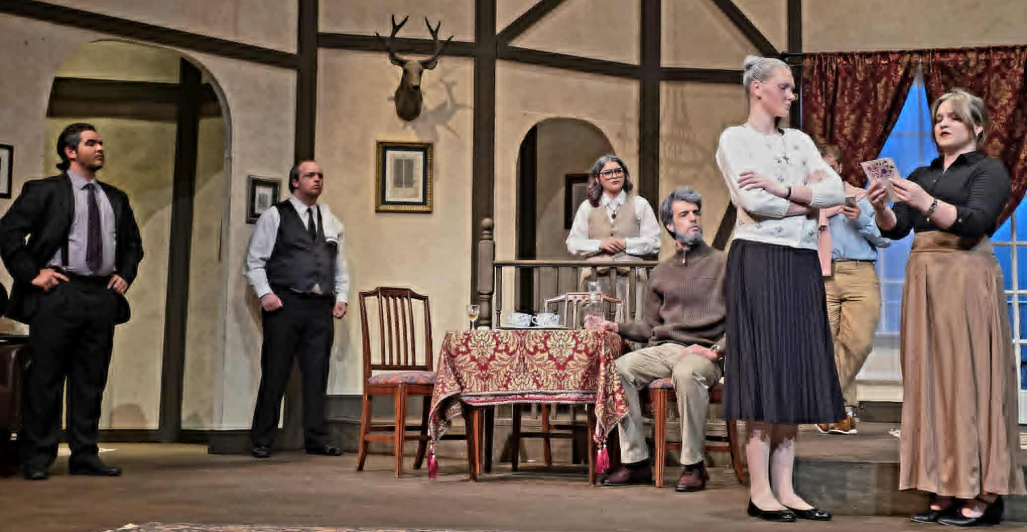
Costume design situates the characters between eras. Some garments evoke mid-century domestic formality, while others suggest contemporary professional attire. A blue dress paired with a white belt and cardigan signals composure and restraint, while a leather jacket worn over a knit sweater introduces a different social register. The clothing, mildly eccentric by contemporary standards, bridges Christie’s narrative moment and the present without calling attention to the mechanism.

Anthony James Marston, played by Robert Wright, introduces an element of contemporary humor through the mannerisms of a social media personality. He carries himself with studied casualness, cotton candy pink sweater draped across the shoulders, pausing to pose with a drink in hand as if aware of an unseen camera. A drone accompanies him, extending the suggestion that observation continues beyond the limits of the room, while eliciting a few chuckles.
The set reinforces this interplay between visibility and concealment. A suit of armor stands beside a stone fireplace, an emblem of inherited authority placed within a domestic setting. The room contains objects that imply lineage and stability, yet the narrative gradually unsettles these assumptions. The careful arrangement of furniture creates pathways through which characters circle one another, avoiding direct confrontation until circumstance removes the possibility of retreat.
Performers sustain the illusion of isolation through disciplined vocal control. Leasia Finley and Dakota Rose Chen maintain convincing British accents that support the geographic setting without distracting from the unfolding drama. Willow Jade Cannon’s portrayal of Dame Lilibet Wargrave demonstrates particular attention to physical stillness, allowing posture and expression to convey authority before the text reveals the character’s deeper significance.

One of Piedmont’s strongest performers, Nealy Webster communicates tension even as her character maintains outward composure among the guests, revealing unease through small shifts in posture and expression as circumstances tighten around her. Christopher Belin brings weight to General Mackenzie, suggesting a man shaped by experience and accustomed to authority, a presence that lends the role its generational gravity. Elsewhere, the character of William Henery Blore played by Ethan Spinks, introduces some of the highest moments of humor in the production. He carries himself with studied ease, drink often in hand, projecting the confidence of someone long accustomed to comfort even as suspicion begins to circulate.
The staging often positions characters in triangular arrangements, reinforcing shifting alliances. In one scene, a seated woman confronts two standing figures, her body drawn inward as tension rises between accusation and denial. The performers allow silence to function as dialogue, acknowledging Christie’s reliance upon psychological pressure rather than physical action. Emotional stakes emerge through posture as much as speech.
Christie’s structure compresses time, concentrating moral inquiry into a sequence of encounters that reveal concealed histories. The island setting denies escape, forcing characters to confront the consequences of actions they believed forgotten. Spiegel’s direction respects this structure, permitting the story to unfold without excessive interpretation. Contemporary details appear without disrupting narrative coherence.

Lighting design contributes to the gradual tightening of the emotional atmosphere. Illumination isolates figures within the room, suggesting that each character occupies a private interior world even while standing among others. The visible horizon beyond the French doors remains constant, reminding the audience that the possibility of departure exists only as illusion.
Once the disembodied voice recites the accusations over the speaker, the gathering no longer resembles a social visit but a reckoning already set in motion. Agatha Christie structures the drama so that the tension arises not from the existence of wrongdoing, which the audience hears plainly, but from the dawning realization among the guests that each name spoken connects to an action carried out long before their arrival on the island. Suspicion gathers as civility gives way to calculation, each character forced to confront the knowledge that no one present stands entirely free of consequence.
Christie’s narrative continues to resonate because it examines the distance between public identity and private knowledge. The Piedmont University production demonstrates that this distance has not diminished with time. The tools of performance have changed, yet the impulse to conceal, justify, and reinterpret remains constant.
General admission seating is $10 for adults and $5 for seniors and students. Admission is free for Piedmont University faculty, staff, and students. Tickets may be purchased online at piedmont. edu/tickets or by calling the box office at 706. 778.8500 x 1355.