The City of Clayton courtroom is lined with pews rather than plastic chairs, and as residents file in dressed in their Sunday best, it feels more like a church meeting than a public hearing on a city ordinance. Neighbors greet each other with handshakes, hugs, and warm calls to friends—but instead of lace gloves, they wear boxing gloves. A Southern Sunday service, indeed.
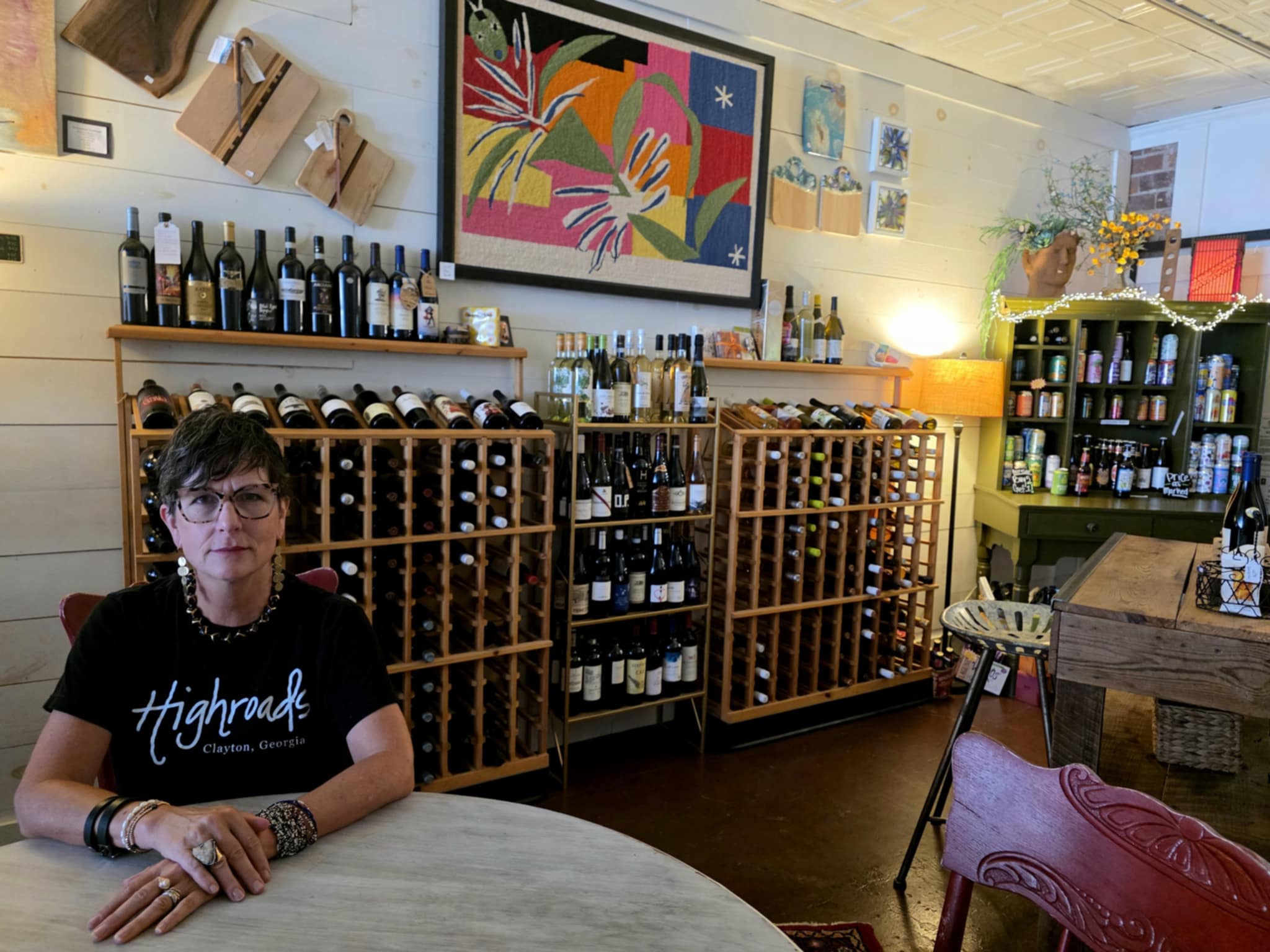
And like a Catholic Mass on a Sunday morning, Highroads has become more than a place to sip a little wine (or, for our Southern Baptist readers, grape juice). It is where neighbors come together as equals, exchanging ideas, fostering fellowship, and nurturing the civic life of Clayton. So it was no surprise to see artists, scholars, business professionals, and teachers seated and standing shoulder to shoulder—united like a congregation—ready to share their perspectives with the council.
The Nebulous Nature of the Ordinance
The city revised the ordinance in 2019. The ordinance limits farm winery tasting rooms to pouring only Georgia wines by the glass. But Highroads specailizes in by-the-glass orders. The very nature of a tasting room gives people variety and invites them to compare and contrast. Thus, they pour wines from Georgia, yes, but also from France, Italy, California, and beyond. Patrons come for the choice, the conversation, and the chance to savor a sunbaked orchard in Spain or a fire-scorched vintage from Oregon.
Hence, if the city enforces the ordinance as they appear to presently interpret it, the bottles will stay corked. And like a glass of wine left sweating on a front porch in the thick summer sun, the liquid will pull back into itself until nothing remains but faint rings.
Sarah Gillespie underscored the confusing nature of the language, saying, “We are reviewing the ordinance. We are not making the decision to alter it today. That does not mean the ordinance won’t be altered. There is, obviously, some confusing language in the way it was written. That’s why you elected us—to do our jobs and make it clearer. We’ve been working on that for weeks now, so please, bear with us. Please.”
She emphasized her support for the business community and signaled her intent to find a resolution.
Tensions flare
Despite those assurances, civility gave way to tension as audience members grew upset over the council’s unwillingness to engage in conversation with them about the ordinance. Council members pointed to their absence of legal counsel as the reason they could not discuss specifics during the 4 p.m. work session.
“The biggest thing is that if we have a difference on our interpretation of our ordinances, it’s not ours to discuss outside of counsel. We need him here to lead us in that,” explained Clayton Mayor Pro Tem Stacey Fountain.
Jabe Hilson, owner of Highroads Tasting Room and Be Effervescent Winery, asked Fountain, “Where is he?”
”He’s on his way back from Atlanta,” Fountain responded.
Hilson pushed back, “That doesn’t help everybody here today, does it? It’ll be another month before we have the opportunity to do that [speak about the ordinance]?” To which Fountain responded, “Jabe, I appreciate you,” effectively shutting down the discussion.
Tensions boil over
The proceedings grew increasingly adversarial as audience members expressed confusion over city council protocols surrounding the public comment portion of the meeting. Many were frustrated to learn that only those who had signed up in advance were allowed five minutes to speak, while everyone else was limited to just one minute to share their views.
About 45 minutes into the hour-long work session, the council intensified this frustration at the proposal to adjourn early, despite many in the audience still hoping to use the remaining time to voice their concerns – even if for only 1 minute.
However, Clayton City Manager Trudy Crunkleton used the opportunity to address the discontented audience, stating, “The attorney has advised us that if y’all are going to say why you are here and what your thoughts are—and I believe we all know what they are—that’s fine. But when it comes to ‘We disagree. Our interpretation…we don’t think we are interpreting it correctly. That we don’t interpret it, and that goes beyond this,” Crunkleton said. “And that is something we can’t say. Because that becomes a legal matter.
She then addressed a member of the audience, “And, back there shaking your head, I’m telling you, our attorney—who is our attorney—says that is why we are not saying more.” Goaded, she raised her voice and clapped her hands to punctuate each word, “Because multiple of you stood up and said, ‘You’re interpreting it wrong. You’re interpreting it wrong.”
She then turned her attention to Jabe Hilson, of Highroads, referencing a private meeting in her office. “Jabe, you and I sat in my office and we agreed how we interpreted it sitting in my office,” she asserted.
Hilson interrupted, disagreeing with her characterization: “Actually, I decided it was not prudent to argue.”
The crowd applauded, prompting Crunkleton to adjust her blouse and hair, then raised both index fingers in the air and respond sharply. “Y’all can all applaud for him, and I want to say, I have been blamed and I have been called out on this, but that is not the conversation you and I had sitting in that room. There was no argument. But you never said, ‘I disagree with your interpretation.’ And so that everybody in this room knows, that was not my interpretation. I went to our attorney before I ever sent anything and said ‘Am I interpreting this correctly?’”
Eventually, as the audience sought clarification on whether the city’s attorney would indeed be present, a retired lawyer stood to ask if City Attorney Mitchell L. Baker Jr. would be available to discuss the ordinance in person. Council members confirmed that he would attend the 5 p.m. meeting.
The council broke for the 15-minute recess, heightening the tension in the room. Yet, many in the audience clamored to address the city’s tasting room ordinance.
Disgruntled audience members used the break as an opportunity to speak directly with council members. Others broke into small groups and discussed among themselves the “openly hostile” and “contemptuous” attitudes they felt some city leaders displayed.
Calls for fairness and clarity
During the public meeting, Hilson described how the issue had affected his business and urged the council to consider granting a temporary variance. He asked that Highroads be allowed to continue operating as it has — offering a wide variety of Georgia, domestic, and international wines — until a formal ruling could be made. In response, Clayton City Attorney Mitchell L. Baker Jr., having arrived from Atlanta, said the city had issued no citations for violations and had not threatened to pull the business’s license.
Baker added pointedly, “And you don’t have to respond to this, but it is my understanding that there were activities going on at this location that were blatantly violations of our alcohol ordinances not related to the serving of non-Georgia wines. Other issues. Which precipitated the communication [Crunkleton’s email].”
Several in the audience demanded specifics concerning the accusation, asking, “What are they?”
Councilwoman Amanda Harrold responded, “This is a communication with us. Thank you.”
Again addressing Hilson, Baker said, “You can respond to that if you want to. Or if you don’t want to. I’m not necessarily saying we need to engage in that. But just for everybody’s knowledge, the communication was precipitated by activities that have nothing to do with why we are here today. It led to this discussion and expression of what the city’s interpretation of the ordinance was, which led to Jabe, you coming and saying, ‘If that is going to be the interpretation, then I would like you to consider changing the ordinance.’”
A cryptic accusation
While the city attorney acknowledged that the issues he cryptically raised were not directly tied to the ordinance debate, he ostensibly pressed the point into the conversation to clarify why no variance would likely be granted.
Baker suggested that the city did not want Highroads to return to business as before, alluding to the unspoken alleged infraction. However, he also noted that the city had not taken action against the business.
Lynda Ann Price, of Highroads, raised her hand to ask what those infractions were, but she was not called upon and granted permission to speak.
“It will be my recommendation to the City of Clayton. I am in favor of clear ordinances that reflect the mores and beliefs of the citizens of Clayton…” he said, adding that he believed the council shared this view at a policy level.
Councilwoman Gillespie then re-emphasized her willingness to work with Hilson to find a resolution.
Public outcry
When audience members were again allowed their turn at the podium, several spoke passionately in favor of Highroads. From artists to attorneys, teachers to business professionals, many described the tasting room as a vital part of Clayton’s civic and cultural life.
One man grew visibly emotional as he recalled visiting Highroads with his late father. Another speaker described it as a “secret chamber of commerce” that helped small businesses, artists, and entrepreneurs connect and thrive.
The Mayor Pro Tem offered an opportunity for individuals to speak in opposition. No one came forward.
In one of the night’s most dramatic moments, retired attorney Kimberly Lacey sought to present a brief constitutional law perspective on the ordinance. Fountain denied her request to speak during the public comment section and called for security to intervene when she protested his decision, even though the hearing once again ended before the time allotted on the agenda. As the city’s police chief moved in to remove Lacey from the room, she announced to the audience that she would deliver her argument on the courthouse lawn. Many in the crowd followed.
A moment of reconciliation
After the city council meeting adjourned, many supporters gathered at Highroads in downtown Clayton to decompress. Gillespie, who had repeatedly emphasized that neither she nor the council sought to drive a small business into closure, stopped by and spoke with those assembled about the public hearing.
When someone remarked on the “rudeness” many in the courtroom had perceived, she offered an apology on behalf of those responsible.
Councilwoman Gillespie reaffirmed her commitment to the community and assured those present that she, too, desired a positive resolution.
As tensions eased in the informal setting, many attendees expressed gratitude for the chance to voice their concerns directly. The evening closed on a note of cautious optimism, with Councilwoman Gillespie’s reassurances leaving some hopeful that a collaborative solution might still be reached.
For supporters of Highroads, the gathering underscored the importance of community dialogue and the shared desire to preserve both local businesses and civic harmony.