I counted eighteen white houses with black trim in the twenty-two minutes since I crossed the border from Gwinnett into Forsyth County. I came to discern the direction of my former hometown and to consider a future that neither romanticized its early-aughts exurbia nor accepted the bleak urban trajectory Jane Jacobs warned of in The Death and Life of Great American Cities.

I wanted to know whether my old hometown still had a soul to salvage, something sturdy enough to stand through the churn and serve both the people who built the place and the newcomers unpacking their boxes. That meant visiting Vickery Village, the polished enclave in west Forsyth defined by its distinctive homes, generous green space, and a cluster of businesses that signal long-term economic and cultural stability.
But as I eased down Windermere Parkway, I noticed a gaping wound where hardwoods once stood, and my knuckles tightened on the wheel. I thought of Windward Parkway in Alpharetta, where growth and greenery have managed a kind of uneasy truce, and I wondered why Forsyth couldn’t strike the same deal with itself.
Then, as I crossed into Vickery, (after battling Exit 13) a faint but real hope rose like a long-held breath. A handful of beloved businesses still held their ground against a rising tide of big, white, boxy structures that confuse price with value and volume with vision. Together, they sketch the bare beginnings of a blueprint for a more human-centered Forsyth County.
Nido Cafe
Stepping from my car, I noticed that the sky resembled the coat of a dapple grey pony. Shades of cobalt and soft white dominate the sky with a curtain of black encroaching from the west. Against that dim horizon, the orange and scarlet leaves burn like the end of a cigar. I stretched and breathed in the glory of that autumn afternoon.
Inside, the café glowed with the lived-in elegance of a historic Parisian apartment. The air carried the mingled scents of espresso and browned butter, the hiss of the milk steamer punctuating the steady hum of mid-afternoon conversation. Two croissants, like a pair of half-moon spectacles, wink at me from the glass case. The lighting was natural, dressed in warm, low-lit accents.
I sat near a table piled with textbooks and pens, and it reminded me of a younger, thinner, darker-haired Carly who once haunted this café when it was the Copper Coin nearly a decade ago. Back then, I could afford only the cheapest coffee, but lingered for hours in true college-student fashion, surrounded by a rotation of friends. I spent dozens of afternoons on the back patio, wrestling with Immanuel Kant and Jean-Jacques Rousseau, long before OpenAI could reduce their arguments to bullet points in seconds.
Today, to my left, two professionals leaned toward one another, a bottle of wine between them and a conference call on speaker. Their conversation wove between business and pleasantries, the language of deals, brie, and cooling spiced tea.

Katelyn Rickards, a hostess par excellence, answered my questions with genuine kindness and tailored suggestions. I asked about her time at Nido, and she offered an unaffected and sincere smile. “I never thought I’d love the food and beverage industry as much as I do,” she said. “I never want to leave.”
A few minutes later, my order arrived: the strawberry basil brie, a croissant layered with basil brie, fried egg, and turkey the perfect companion to a delightfully foamy cappuccino. I finished lunch, then asked for directions to my next stop.
The Flower Post
“Eighteen years,” says Karrey, the co-owner of The Flower Post, when I ask how long the shop has been in business. The word boutique is no exaggeration. Each arrangement is a work of art, part French pastry, part Victorian still life, crafted by hand for weddings, baby showers, and birthdays. They seem drawn from another world, elegant yet familiar, like something found beneath a gilded mirror or beside a pumpkin stand in autumn.
As we talk, I realize for the first time why I love flowers, not just that I love them.

I confessed to Karrey that I once discouraged my husband from buying me flowers, writing them off for their short life span, but that my feelings on that subject had softened over the years. She contends that the beauty of flowers derives precisely from their transience and that they matter because they do not last, not despite that truth. “Even though they’re cut, and yes, they’re going to die,” she says, “in that breath of that moment, they’re very much alive. They’re showing off for you, bringing you some kind of emotion.”
Their short life is what gives them weight, and their beauty loses little in the fading. Especially when one recognizes that few gifts, when examined closely, hold their novelty for long. A stuffed bear becomes clutter, a painting dims, and the little decorations we buy and replace shed their charm with time.
Flowers, though brief in their stay, can thrive for weeks when tended to.They fill a room with fragrance and color and with the gentle reminder that someone chose a specific bloom for you, believing it fit who you are or would bring you a smile.

Karrey describes flowers as “emotive,” capable of stirring something deep within us that we often forget amid the pace of ordinary life. “There’s not enough of that goodness in the world,” she says. “Even one flower can sometimes give you a feeling.” To this, I think of the carnation a friend sent me in middle school on Valentine’s Day and the jolt of joy it brought on that occasion.
In the past year, through my work as an event planner, I came to fully understand the power of flowers. I noticed how real blooms turn a plain table setting into a place that welcomes an occasion. Even the most convincing imitation felt hollow beside a living arrangement. A vase of lilies lends matronly elegance; a bundle of sunflowers brings mischief and whimsy. Both make a room more intentional.
And then there is The Flower Post itself, which feels like the setting of a fairy tale. Branches coil across the ceiling like an enchanted wilderness, their dried blossoms whispering above as if held there by a fading spell.
The brick floor stretches beneath a soft canopy of vines and drifting petals, as though one has stepped through an iron gate into an Edwardian conservatory kept secret. Tables brim with marigolds, orchids, and velvety moss, treasures gathered from some half-tamed garden just beyond sight. Along the walls, shelves cradle arrangements both intentional and wild, poised between poetry and twilight. They feel as windswept as a Yorkshire moor and as refined as a debutante descending a Cinderella staircase.
After a final photograph, I bid my hosts good afternoon and slip back into the soft rain, crossing the street to the little restaurant opposite The Flower Post. It waits there just as I remember it.
Cinco Cantina
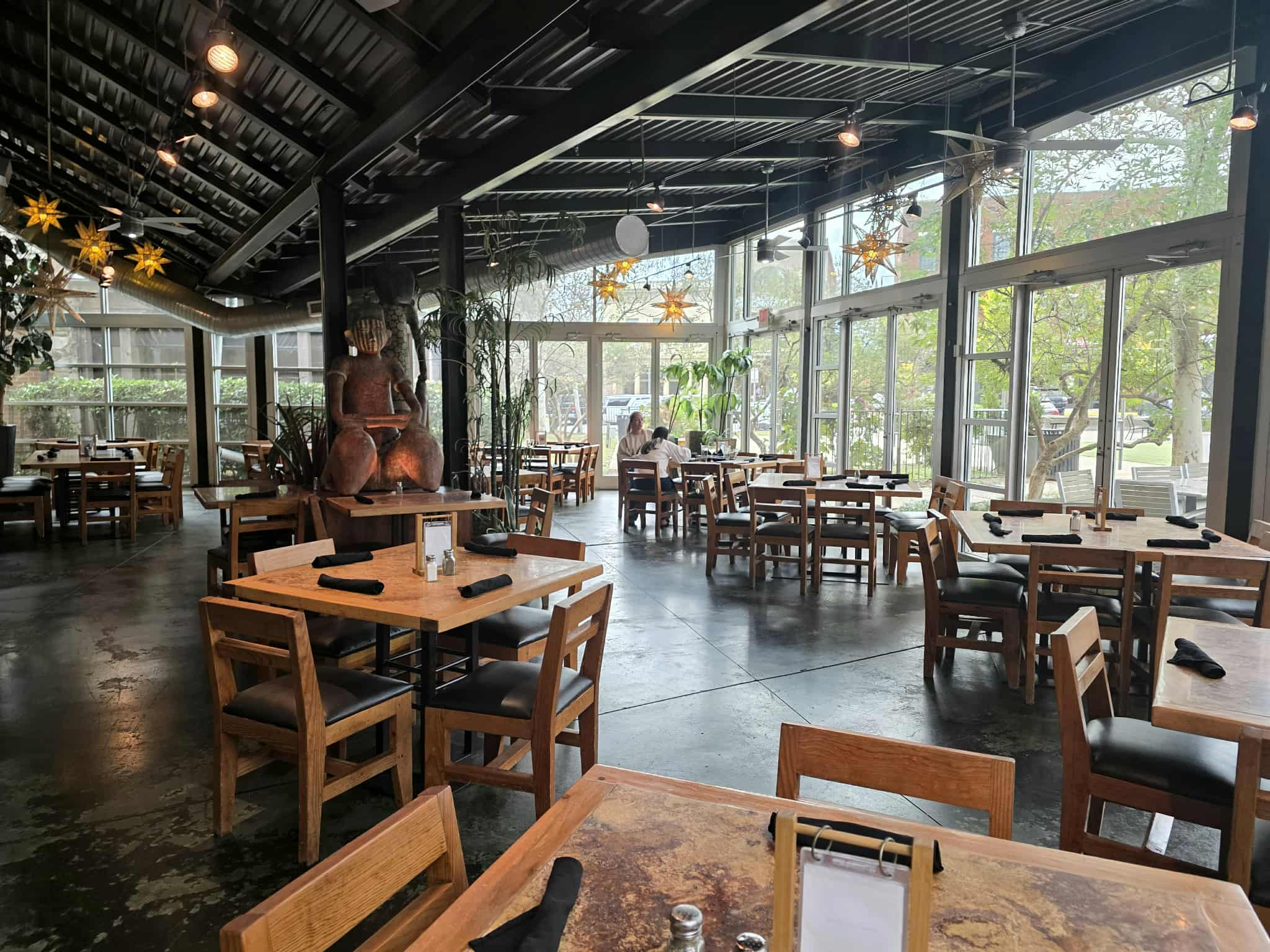
This Mexican cantina unfolds across three distinct dining spaces, each with its own mood and visual identity. The main indoor dining room is vibrant and artistic, with colorful walls, modern pendant lights, and bold cultural artwork that set a lively, inviting tone. Warm wood tables, high ceilings, and industrial details give the room an energetic, urban feel.

Just beyond it sits the glass room, a light-filled oasis wrapped in floor-to-ceiling windows. It feels like a modern conservatory, blending natural light with contemporary design. Oversized plants, star-shaped hanging lights, and sculptural elements make it one of the most atmospheric corners of the restaurant.
It’s at the entrance that I met Nathan, a sharp and earnest young man who has worked at Cinco for five years. He speaks of the restaurant with sincere pride, describing the team as family and his role as something more than a job. There’s no trace of rote professionalism in his voice; instead, his words carry genuine affection for the people he works with.

The menu reflects that same sense of care. It features a colorful lineup of handcrafted margaritas, from the classic lime to mango, peach, and passionfruit, each one made to order with top-shelf tequila and fresh citrus. For something bolder, I flag a specialty cocktail called the Midnight Smoke, a blend of smoky agave and bright lime. Tequila fans will find plenty to love, with an impressive selection that ranges from smooth silver to deep, rich añejo.
Guests can pair their drink with tacos, sizzling fajitas, or fresh guacamole for a perfect Cinco experience. And for wine lovers, the menu offers both red and white selections, along with a crisp assortment of draft and bottled beers for every taste.
What We Can Learn
As I step back into my vehicle, I sense with urgency that Forsyth County sits at a crossroads. Growth accelerates. New corridors run in long, treeless lines. Generic homes rise on scraped clay. People notice the change and talk about it in grocery store parking lots and at youth pickleball practice. The county keeps expanding, even as something real and meaningful slips away.
Vickery Village offers a counterpoint. The district sits tucked into west Forsyth, where sidewalks meet storefronts and mature trees coax the built environment into compromise. Homes stand close enough to feel like a real neighborhood, but not so tight that the usual neighborly grudges have room to grow. Greenspace interrupts the geometry of development, and thus people gather and linger on benches and Adirondack chairs.
Forsyth as a county can learn from this small district. It can choose development that protects trees and encourages walking. It can support projects that mix homes, parks, and shops rather than scatter them across miles of roadway. It can create spaces that value identity over speed. The county does not need to halt growth to recover character. It only needs to study the places that still hold it.
Vickery Village offers that lesson with clarity. It reminds Forsyth that a community thrives when it builds for people, not for the ease of developers, and that beauty, scale, and intention form the groundwork for a future that still resembles a home.