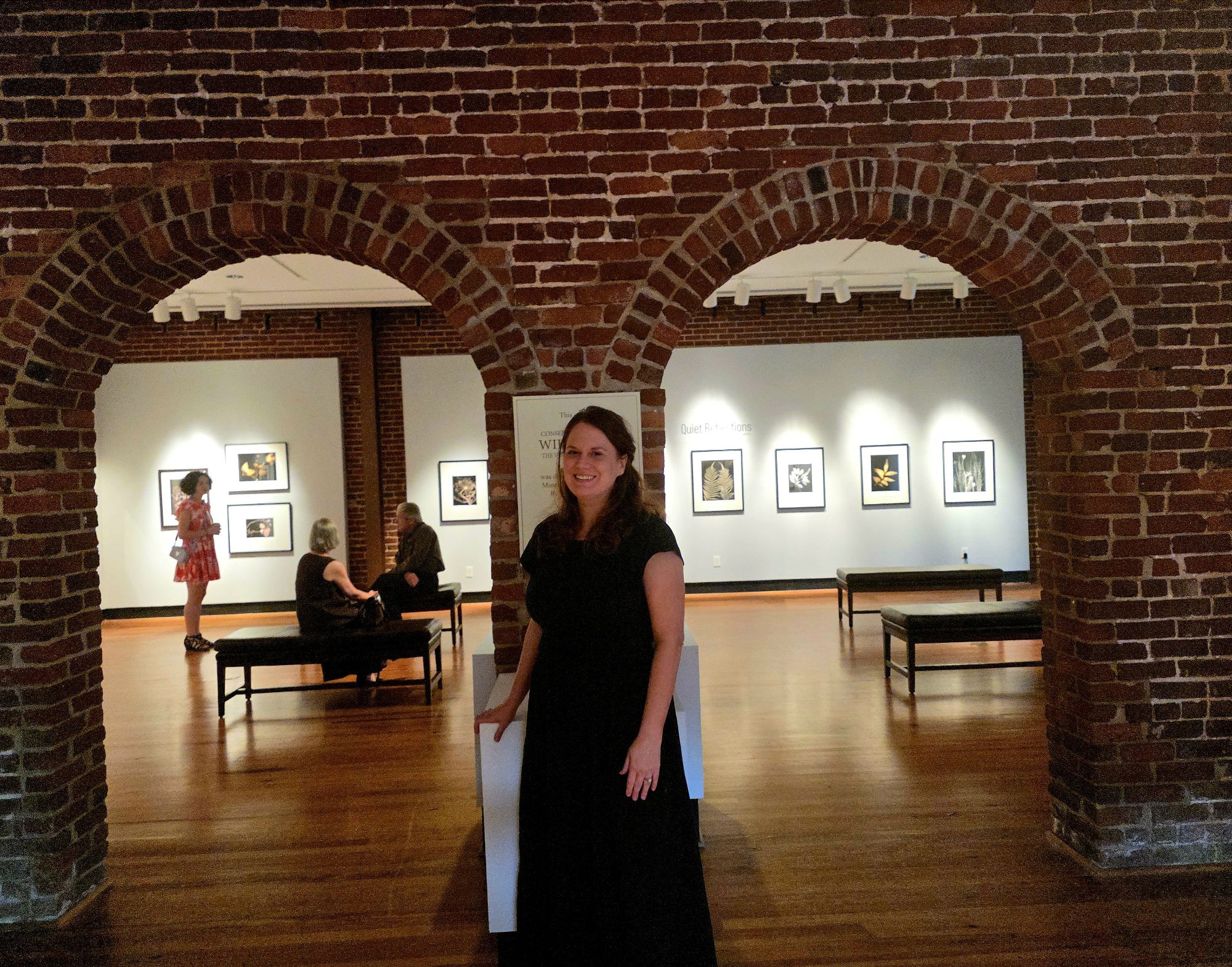
On a weekday afternoon in Demorest, Rebecca Brantley drags a ladder across the brick floor of the Mason-Scharfenstein Museum of Art. She steadies it against a wall of exposed brick, climbs halfway up, and tapes a fresh label beside a new work. In another hour, she will walk across the street to campus and teach classes at the University.

Brantley directs the museum and teaches art history, design, and related courses at Piedmont University. She writes reviews, manages budgets, and organizes community workshops. When the workday stretches late, she cleans up after receptions or drafts the next round of press releases. She calls the role “slashy,” shorthand for the string of jobs that now define creative life. “Creative people have to embrace being more than one thing,” she explained.
A Regional Mission
The Mason-Scharfenstein Museum opened in 2011 in a renovated café on Demorest’s main street. Exposed steel beams cut across the ceiling, and Demorest brick lines the walls. The space holds permanent galleries and rotating exhibitions. The mission is simple: bring art to a small campus and to a region that has long lacked easy access to it.

Brantley curates with the South in mind. She brings in artists who respond to the land and to the culture around it. At this moment, Ann Beason and Merri Lawrence fill the gallery with camera-less photographs, images made in the darkroom with garden plants and translucent materials. In October, photographer Rhett Turner will show images of his father Ted Turner’s conservation property, a body of work that records bison and restored grasslands. “We want to reflect art from the South and from Appalachia,” Brantley said. “It matters that people see their own landscape and culture in the work.”
Work That Reaches Beyond Campus
The Mason-Scharfenstein Museum of Art draws students and faculty from Piedmont University, but director Rebecca Brantley insists on reaching further into the community. Families often stop in for receptions, workshops, and special events.
This fall, the museum will host a children’s exhibit with Cornelia-based illustrator Jan Walker, who will recreate collages from her fairy-tale book The Kingdom of Neep. On Halloween, the museum plans cider and candy, a pumpkin contest, and a welcome for costumed children—an extension of its mission to be both a campus gallery and a regional cultural hub.
“We want to hear from people what they want to do,” Brantley said. “We want the community to feel like this belongs to them.”
A Demanding Role
That push for relevance requires more than scholarship. Brantley plans budgets, raises money, recruits volunteers, and coordinates with city events. She teaches courses in art history, design, and appreciation. In her elective classes, she assigns sketchbooks and potato prints, weaving her own background as a painter and writer into her lectures.
She does this because the work requires it. Larger museums in Atlanta or Charlotte employ specialists for marketing, education, and installation. In Demorest, Brantley wears all of those hats. The role demands administrative skill and community diplomacy as much as curatorial judgment.
A Broader Pattern
Brantley’s “slashy” description echoes across the art world, especially outside major cities. Curators balance teaching loads, grant writing, and part-time consulting. Artists take on nonprofit work, commercial design, or academic research. “You don’t get to stay in one lane,” she said. “You build a career by stitching things together.”

The Mason-Scharfenstein Museum makes that necessity visible. Its staff runs student capstone shows two or three times a year. They coordinate a group pop-up each spring as part of the university’s research symposium. They rotate in ceramics, photography, and collage alongside traditional painting. The museum hosts receptions with local food and invites artists to speak about their process. Each event requires the curator to move quickly from one task to the next.
Why It Matters
In a county where public schools report 17 percent math proficiency at the high school level and below-average reading scores in elementary grades, cultural institutions carry weight. They offer children and families access to ideas, experiences, and creative practices that school systems alone cannot supply. For Brantley, that weight explains the long hours.
“We try to focus on art that brings enrichment,” she said. “If kids and families come in here and feel like they belong, then we’ve done our job.”
Looking Forward
The next season fills quickly: Rhett Turner’s photography in October, Jan Walker’s collages in November, ceramics in the spring, and student shows scattered in between. Brantley will climb ladders, tape labels, pour cider, and send emails. They will keep the doors open with suggested donations, not ticket prices.
It is not always glamorous work, but it sustains an institution in the foothills of Southern Appalachia. Brantley teaches, curates, and improvises because the museum and the region demand it.