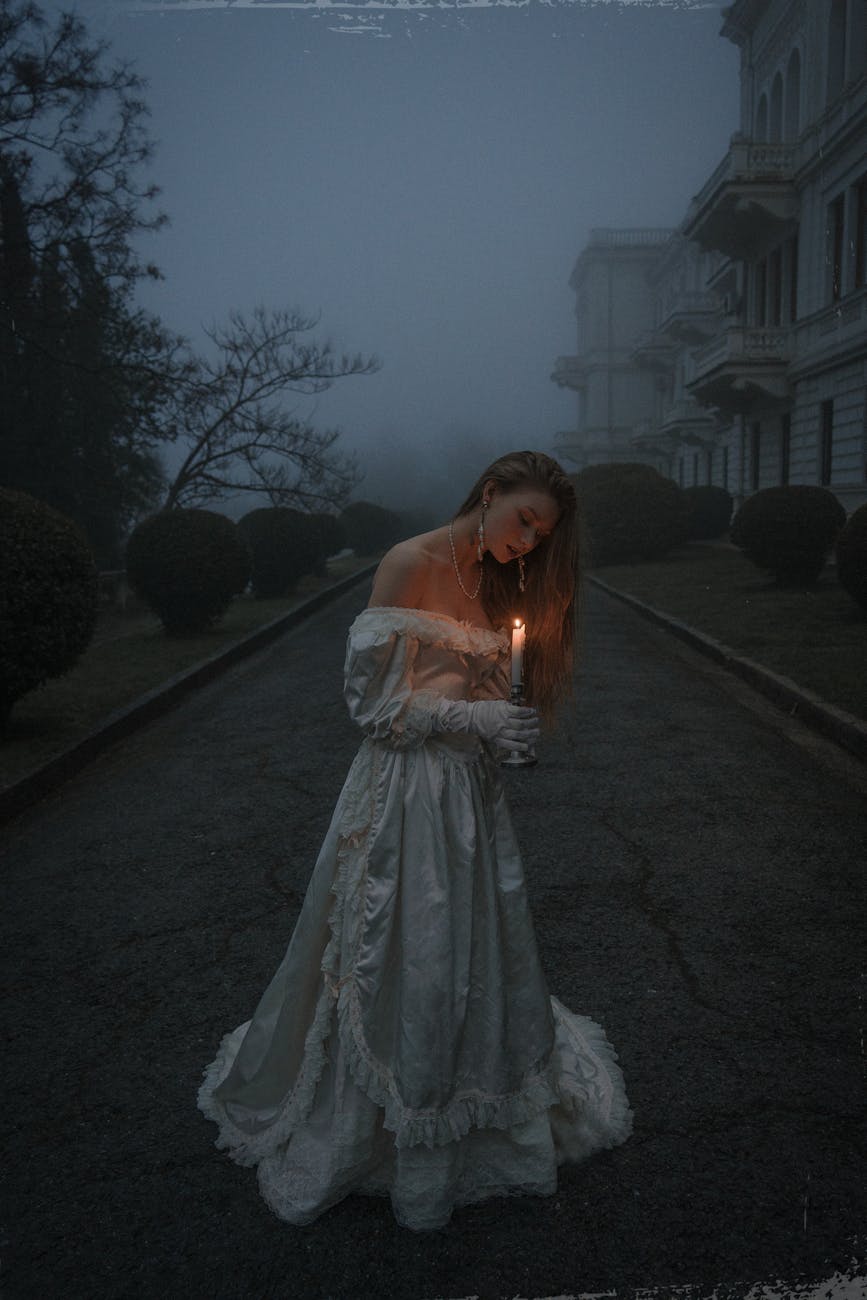
Nosferatu may not draw a packed house, but those who venture into its shadowy Carpathian corridors will find themselves unable to leave their seats when the credits roll. At my screening, only 20 people attended and 20 lingered in spellbound silence for a full three minutes after the lights came up–caught in the film’s vampiric influence.
Director Robert Eggers, of The Lighthouse fame, revisits Nosferatu, the silent-era horror classic, with a deliberate focus on its enduring themes of obsession and dread. With Willem Dafoe, Bill Skarsgård, and Lily-Rose Depp leading the cast, Eggers grounds the story in its gothic roots while reimagining it for a modern audience. His meticulous approach captures the eerie, shadow-drenched atmosphere of the original, using it to explore the darker recesses of human longing and despair.
Bill Skarsgård commands the screen as Count Orlok, a towering figure of waxen skin taut over fetid flesh, shrouded in a fur-lined cloak of deepest black. Every extension of his tapered fingers and harsh, gravelly voice evoke the primal instinct to flee. In contrast, Nicholas Hoult’s Thomas Hutter serves as the audience’s surrogate, charting a descent from a naive post-graduate and devoted husband to a man who experiences every shade of fear, despite the film’s muted palette.
Meanwhile, Lily-Rose Depp’s Ellen anchors the film emotionally, her fragility—both psychological and social—showcases her struggle against Orlok’s looming presence while she strives to maintain a tenuous position on the fringes of upper-class society. Depp imbues the character with layers of agency and inner turmoil that were absent in earlier adaptations. Eggers expands her role, transforming Ellen into a figure of both sacrifice and quiet defiance, her connection to Orlock as much psychological as supernatural.
For his part, Willem Dafoe, as Professor von Franz, infuses the narrative with fiery gravitas, wielding both torches and a relentless sense of purpose in his nod to Van Helsing’s archetype.
The movie begins with a testament to the hustle of real estate agents everywhere and in all times. Thomas Hutter is ordered by the head of his estate firm to the furthest reaches of the Carpathian Mountains in Romania to present contracts to the eccentric and isolate Count Orlock. After weeks of travel, he begins the ascent to Count Orlok’s castle. As he navigates the dense, fog-choked forest, a riderless carriage—more inkblot than vehicle—appears. He hesitates, then climbs in, and the carriage swallows him whole.
Upon arriving at the estate, the audience and Thomas meet Orlock, and at this point, I am physically squirming as far from the screen as I am capable, even as Thomas Hutter is squirming in his own high-backed chair. There are times when I even cover my face in dread and anxiety watching the film through my fingers.
Yet, this dread and anxiety are precisely why one watches a Robert Eggers film. It’s a bold statement, but no 21st-century director plunges the audience into the raw, unsettling frenzy of his stories quite like he does. As the narrative unravels, so does emotional restraint—and arguably, even one’s grasp on reality, as one must remind oneself the work before them is fiction.
Even as Thomas wages an internal war, grappling with the feverish manipulations of Orlock and ultimately fleeing by leaping from a window into a river with wolves in pursuit, Ellen remains a steadfast guest to her beloved friend and unwilling husband. As Orlock’s hold on her strengthens and he crosses the ocean to claim her, Ellen succumbs to paroxysms, haunted by his presence as he infiltrates her dreams.
As with his previous works, Eggers grounds the fantastical in a rigorous historical context. The cobblestone streets of Wismar, the dense, unyielding forests of Romania, and the creaking timbers of Orlock’s castle feel painstakingly real, each location steeped in texture and atmosphere. This meticulous attention to detail underscores the film’s central theme: the collision of the ancient and the modern, the known and the unknowable.
Perhaps most compelling is Eggers’ ability to retain the tragic undercurrent of Nosferatu. While Orlock is undoubtedly a monster, he is also a symbol of eternal longing and insatiable hunger—a creature damned by his very nature. Eggers amplifies this tragedy, crafting a narrative that feels as much about existential despair as it is about bloodthirsty horror–but certainly there is that too.
However, even a masterpiece has its flaws. The film’s length feels self-indulgent, with at least 40 minutes that could have been left on the cutting-room floor without sacrificing its impact. Moreover, Count Orlock’s ragged groaning and labored breathing—while undoubtedly terrifying and unsettling—veer into irritation at times. Perhaps the intent was to make viewers long for silence, amplifying the character’s oppressive presence. Or perhaps it simply became frustrating. Honestly, I’m not sure.
For those who dare to step into Eggers’ reimagined Nosferatu, the rewards are immense. It is a film that doesn’t simply seek to scare; it aims to haunt, linger, and, like Orlock himself, leave a lasting mark on its victims. Whether it’s the flicker of a candle in the dark or the slow, deliberate rise of a shadow on the wall, Nosferatu under Eggers’ direction is a masterclass in cinematic unease—a work that honors its roots while forging its own singular path into the annals of horror.